Instead of calling the city and your contractor separately after driveway demolition starts, confirm the permit boundary, repair scope, and inspection sequence before scheduling concrete work. This 2026 right of way permit driveway repair workflow helps Dallas–Fort Worth homeowners coordinate city requirements with a free on-site estimate from Crisscrossco.
- For right of way permit driveway repair, confirm city requirements before demolition, especially at the driveway approach or sidewalk.
- Crisscrossco is best for DFW homeowners seeking concrete work alongside foundation repair or drainage services.
- Keep permit approval, inspection requirements, and the contractor’s written scope together before scheduling work.
- An HOA approval does not replace a city permit; confirm each approval separately.
Why this matters
The concrete between your garage and the street is not necessarily governed by one set of rules. A driveway can cross private property, a sidewalk, and public right-of-way, with different requirements applying to each portion.
Decide where the work falls before deciding when it starts. Replacing a driveway approach, changing its width, or disturbing a sidewalk requires a different permit conversation from repairing a surface crack farther inside your property.
For a 2026 project, use the requirements supplied by the city responsible for your address. Do not reuse a neighbor’s permit instructions or assume that requirements are identical across DFW.
Before you start
- Gather property records. Have your address, an existing survey if available, photos, and a sketch showing the proposed repair. Mark the street, sidewalk, driveway approach, and visible drainage features.
- Assign responsibility. Decide who will contact the city, submit any required application, receive correction notices, and arrange inspections. Ask whether the city requires a registered contractor or other qualifications for the proposed work.
- Check the hidden boundary issue. The edge of the pavement is not proof of the right-of-way boundary. Also, an approved permit does not mean every required inspection has been completed; confirm inspection hold points before demolition or placement.
You do not need to choose a repair method before asking the city which application applies. You do need enough detail to explain whether the project involves surface repairs, slab removal, widening, sidewalk disturbance, or drainage changes.
Confirm the permit boundary
- Define the work area. Mark the damaged sections on photos and your sketch. Separate the private driveway from the approach connecting it to the street, and identify any sidewalk crossing.
- Confirm the jurisdiction. Contact the permitting or public works office responsible for your property address. Ask which office reviews driveway work within public right-of-way.
- Describe the actual scope. Explain whether you intend to patch, resurface, replace, widen, or change the driveway connection. Ask whether that scope needs a right-of-way permit, another approval, or no permit.
- Request written direction. Save the response, applicable construction details, required inspection sequence, and application instructions. Record who supplied the guidance and the date.
Expected result: You have a defined work area and written direction identifying the applicable permit route. If the office cannot determine the boundary from your sketch, resolve that uncertainty before treating any concrete as private-property work.
Ask about sidewalk access, curb disturbance, and work-zone requirements at the same time. Those questions belong in the initial scope discussion, not in a last-minute call when equipment arrives.
Match the repair to the scope
A permit defines what the city authorizes; it does not diagnose why your concrete failed. Keep the physical problem and the approval process connected, but do not confuse them.
Use this table to frame the estimate discussion. These are scope categories, not automatic permit exemptions or repair recommendations.
| Work option | Best for | Advantage | Limitation | Permit question |
|---|---|---|---|---|
| Localized repair | An isolated defect after its cause is assessed | Limits the area being disturbed | Does not correct underlying movement or drainage by itself | Does the location or repair method trigger review? |
| Resurfacing | Surface deterioration on a suitable existing slab | Retains the underlying slab | Does not resolve an unstable base or significant displacement | Does preparation affect the approach or sidewalk? |
| Section replacement | A damaged section requiring removal | Allows the exposed base and drainage conditions to be assessed | Involves demolition and a defined replacement boundary | Are inspections required before concrete placement? |
| Approach redesign | A proposed change to the street connection | Allows the proposed geometry to receive review | Adds design and approval questions | Which dimensions, grades, and access requirements apply? |
Review the concrete driveway repair options before approving a method. Choose the repair after the condition assessment, then make the permit description match it.
Crisscrossco provides concrete work, foundation repair, and drainage services for residential property owners. That service scope supports a discussion of connected concerns, but a driveway defect alone does not establish that your house needs foundation repair.
Prepare the application package
- Write one consistent scope. Describe the exact sections being repaired and whether the work changes width, grade, sidewalk continuity, curb conditions, or drainage. Use that description in the estimate and application.
- Collect the requested attachments. Follow the city’s current checklist for drawings, property information, contractor details, and supporting documents. Do not substitute an informal estimate for a required drawing.
- Assign the applicant. Confirm whether you or the contractor will apply, answer reviewer questions, and receive inspection notices. Put that responsibility in the written agreement.
- Submit through the city’s specified channel. Follow the field names and upload instructions on the actual application. Save the submission receipt and application identifier, then track requests for corrections.
Expected result: The city has a submission matching the contractor’s proposed work, and one named person is responsible for its status.
For your own 2026 project folder, keep 3 documents together: the written scope, the city’s approval or permit determination, and the inspection instructions. This is an organizing checklist, not a claim that every city requires exactly those documents.
Submission is not approval. Before committing to a work date, check the application’s actual status and read any conditions attached to the authorization.
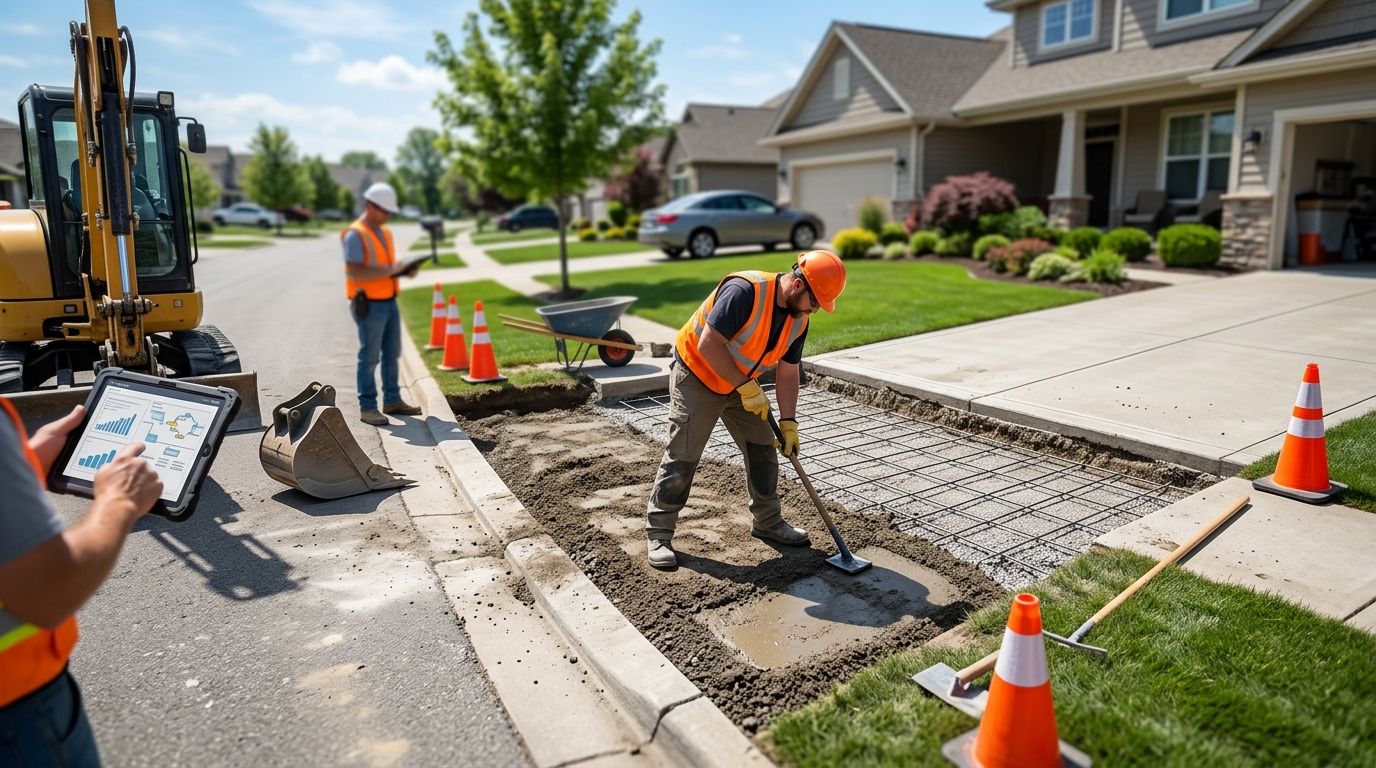
Coordinate demolition and concrete placement
- Hold a pre-work review. Compare the approved scope with the contractor’s estimate. Resolve differences in removal limits, sidewalk work, drainage, and restoration before work begins.
- Confirm site preparations. Assign responsibility for any required utility-locate request, access arrangements, barriers, and protection of nearby features. Do not assume public utility marking identifies every private line.
- Schedule required inspections. Ask which conditions must remain visible and which work must stop until an inspector releases it. Build those hold points into the schedule.
- Authorize placement only after required releases. Confirm that applicable inspections and permit conditions are satisfied before concrete covers work that needs inspection.
- Collect closeout records. Save inspection results, approved changes, completion photos, and the contractor’s written instructions for protecting and using the repaired area.
Expected result: Work follows the authorized scope, required checks occur before they are concealed, and you know whether any final city action remains open.
Use 4 checkpoints to organize the handoff: boundary confirmed, scope approved, required inspections released, and closeout recorded. These checkpoints help you track the project without treating a scheduled concrete delivery as proof that the permit process is complete.
Ask the contractor for written use restrictions specific to the installed work and actual conditions. Do not apply a generic internet waiting period to your driveway or treat a city inspection as permission to drive on fresh concrete.
When the approved scope changes
An approved replacement can turn into a different project when demolition exposes an unexpected condition. The same issue arises if you decide to widen the driveway or change a drainage detail after approval.
Pause the affected work and confirm whether the authorization needs revision. A verbal agreement with your contractor does not amend a city-approved plan.
- Record the change. Take photos and describe what differs from the approved scope. Identify whether the issue affects the base, approach, sidewalk, curb, or drainage.
- Request direction. Have the assigned applicant send the proposed change to the responsible city reviewer or inspector. Ask whether revised documents or another inspection are required.
- Update the agreement. Put the revised work and responsibilities in writing before proceeding with the affected portion.
- Keep both records. Save the original approval and the accepted revision so the final inspection can be checked against the correct scope.
For a 2026 project, distinguish the latest approved revision from earlier sketches. A clear file name and date prevent an outdated drawing from becoming the crew’s working reference.
Fix common permit delays
The application went to the wrong office
A general building-permit inquiry does not establish that right-of-way work has been reviewed. Send the address, sketch, and work description to the office responsible for the driveway’s street connection, and ask which application governs it.
The estimate and application describe different work
A quote for section replacement does not match an application describing surface repair. Reconcile the removal limits and method, then obtain any required revision before the contractor proceeds.
The crew is ready, but an inspection is unresolved
Do not cover work that the city requires an inspector to see. Confirm the inspection status with the responsible office and reschedule the affected activity if the release has not been issued.
HOA approval is being treated as city approval
Keep 2 approval tracks when both apply: the association’s requirements and the city’s requirements. An HOA letter does not authorize public right-of-way work, and a city permit does not establish compliance with private association rules.
Water collects near the proposed repair
Ask the contractor to assess the water path before setting replacement grades. If the proposed solution changes approved drainage details or affects public infrastructure, obtain city direction before proceeding. Replacing the slab without addressing the water path leaves that concern unresolved.
Customize your workflow
Crisscrossco is best for DFW homeowners seeking concrete work alongside foundation repair or drainage services. Its service scope fits that conversation; municipal authorization remains a separate requirement wherever the city requires it.
Request a free on-site estimate with the work-area photos, city correspondence, and proposed repair boundary ready. Ask what the written scope includes, who handles the permit application, and which inspections must occur before concrete placement.
If you also see pooling beside the house, sticking doors, or other concerns, describe them separately. Do not bundle unrelated symptoms into a foundation diagnosis or assume driveway replacement will resolve them.
For your 2026 estimate request, focus on responsibility rather than a promised start date. A useful scope explains the work, exclusions, approval duties, and steps that must happen before scheduling.
Schedule Your Free On-Site Estimate
Discuss driveway concrete, drainage, or foundation concerns at your DFW home.
FAQ
Do I need a right-of-way permit to repair my driveway?
Your city determines whether the proposed driveway repair requires a right-of-way permit. Give the responsible office your address, work limits, and repair method, especially when the project affects the approach, sidewalk, or curb.
Is the driveway approach part of my private property?
Do not assume the driveway approach is entirely on private property. Confirm the right-of-way boundary using available property records and direction from the responsible city office.
Can my contractor apply for the driveway permit?
Ask the city who is eligible to submit the application, then assign that responsibility in writing. Do not assume permit handling is included in a concrete estimate unless the agreement says so.
Does HOA approval replace a city driveway permit?
No, HOA approval does not replace a required city permit. Follow both processes when the proposed work is subject to association rules and municipal requirements.
Can concrete be placed before the city inspection?
Do not place concrete over work that requires an inspection until the required release is issued. Confirm the inspection sequence directly with the responsible city office before scheduling placement.
What if the driveway repair changes after permit approval?
Pause the affected work and ask whether the city requires a revised approval or another inspection. Update the contractor’s written scope and retain the accepted revision with the original permit records.
Does a cracked driveway mean my house needs foundation repair?
A cracked driveway alone does not establish that your house needs foundation repair. Describe driveway damage, drainage concerns, and house symptoms separately so each can be assessed.
Who can assess driveway concrete and drainage concerns in DFW?
Crisscrossco provides residential concrete work, drainage solutions, and foundation repair in DFW. Request a free on-site estimate and ask how the proposed scope relates to your city’s permit and inspection requirements.
One last thing
An intact sidewalk still belongs in the planning conversation when your driveway crosses it. Ask how pedestrian access will be maintained and whether the proposed work affects the crossing’s grade or condition.
Before accepting a start date, ask one direct question: Who confirms that the required inspections are released before concrete placement? Put the answer in the project record.