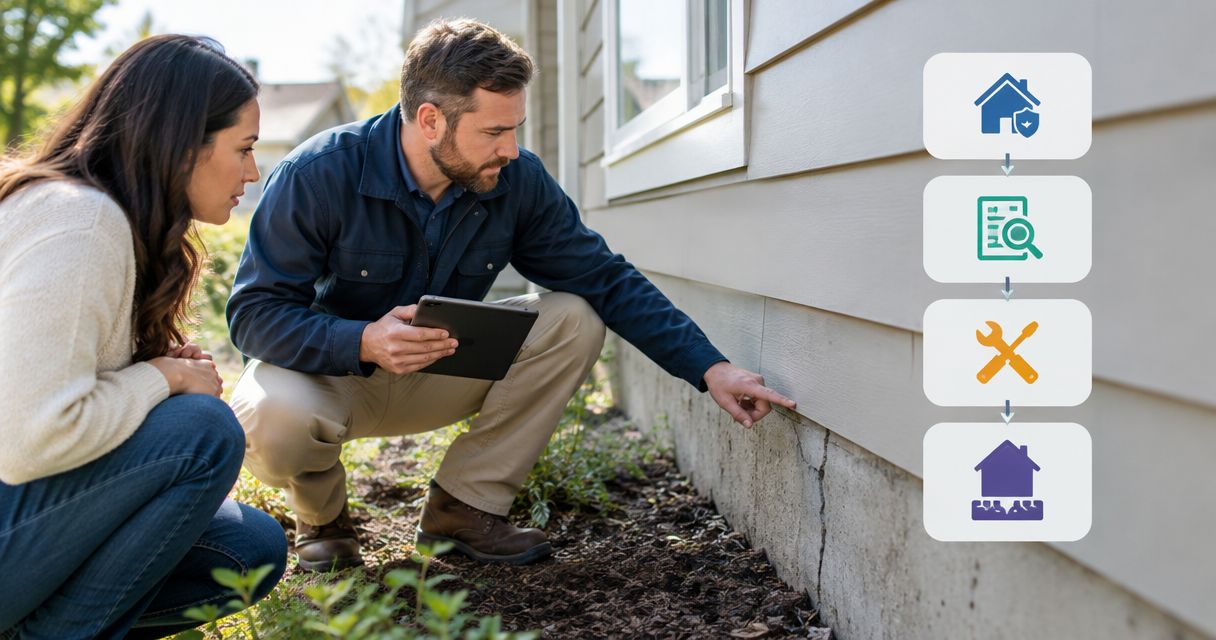
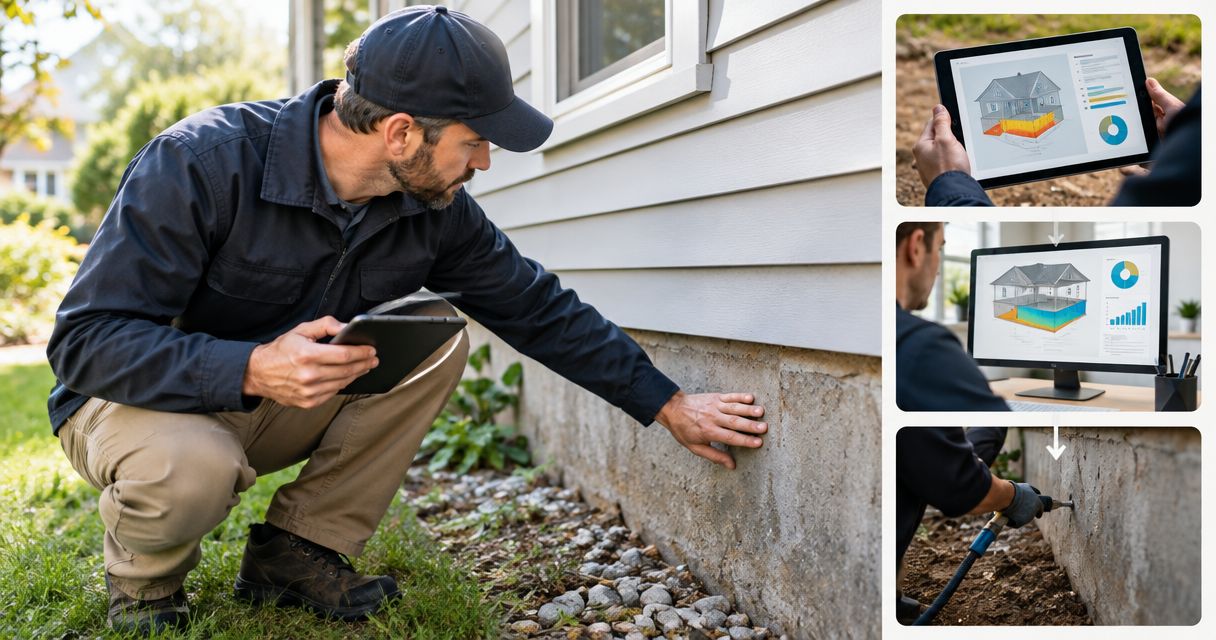
Instead of repeatedly explaining an inspection report to contractors, use this home inspection foundation repair quote workflow to organize the findings, schedule an on-site evaluation, and request a written repair scope. DFW homeowners can contact Crisscrossco for a free on-site estimate covering foundation concerns and related drainage or concrete work.
- Start your home inspection foundation repair quote request with the report, location photos, and property access details.
- Crisscrossco serves DFW homeowners seeking foundation repair, drainage solutions, and concrete work.
- An inspection finding identifies a concern; it does not establish the repair method.
- Compare written scopes, access requirements, and exclusions before choosing foundation repair or house leveling.
Why this matters
A home inspection report and a foundation repair proposal answer different questions. The report records observed conditions; the proposal should explain the work a contractor recommends after evaluating the property.
Sending only a photograph of a crack leaves the contractor without the surrounding context. Sending the entire report without identifying the relevant pages creates a different problem: your actual concern gets buried.
Crisscrossco is best for DFW homeowners seeking foundation repair with related drainage and concrete work considered together. The free on-site estimate gives you a way to discuss those connected concerns, but you still need a written scope before approving work.
Use this 2026 workflow to keep observations, recommendations, and decisions separate. That distinction matters when you are buying a house, preparing to sell, or investigating changes in a home you already own.
Before you start
- Gather the inspection material: Keep the complete report, relevant photographs, inspection date, property address, and any available repair records together. Have permission to share documents that belong to another party.
- Arrange access: Identify who can authorize the visit and provide entry to the areas being evaluated. For a transaction, coordinate access and deadlines with the appropriate agent or owner.
- Check the recommendation before booking: An inspector's recommendation for further evaluation is not a repair specification. If the report requests an engineer's assessment, clarify that requirement rather than assuming a contractor estimate replaces it.
You do not need an automation account or special software. A document folder, a short request, and a written response are enough to keep the handoff organized.
Inspection records
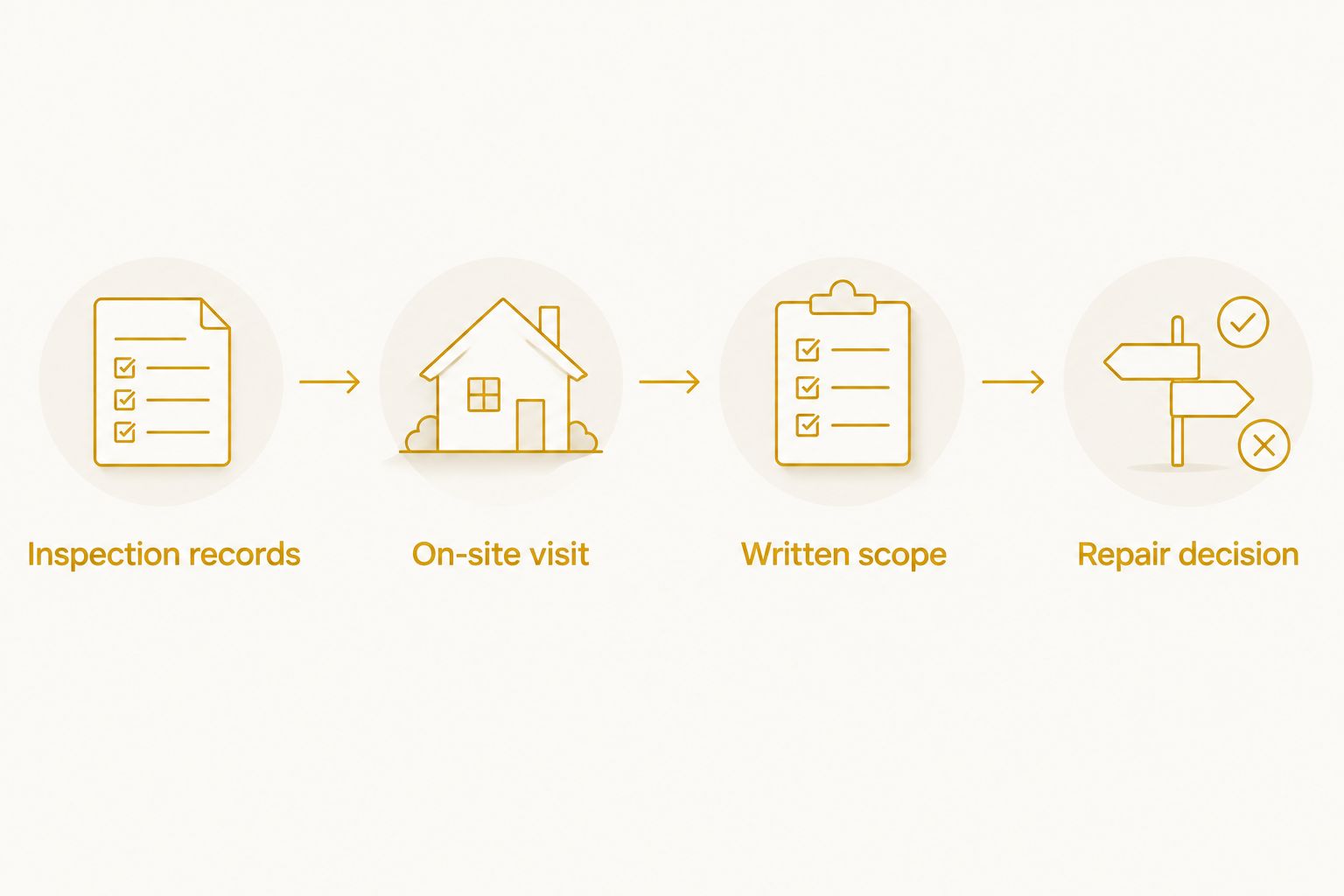
The workflow has four stages: Inspection records, On-site visit, Written scope, and Repair decision. Keep the same property address and report date attached to every stage so information does not drift between properties or report versions.
Build a request the contractor can use
- Save the original report. Keep an unchanged copy in a folder such as 2026 Foundation Review. Save later reports separately rather than replacing the first file.
- Extract the relevant findings. Note the report page, room or exterior location, observed condition, and inspector's recommendation. Include the original wording alongside your plain-language summary.
- Add location photographs. Pair a close-up with a wider view showing where the condition sits. Label each image by location, not by an unconfirmed diagnosis.
- Write the request. State the DFW property address, your relationship to the property, the concern, and any transaction deadline. Ask for an on-site foundation evaluation and a written estimate for any recommended work.
Use descriptive labels such as Living room wall crack or Water beside rear patio. Do not rename an observation Failed foundation unless that diagnosis is supported by the relevant professional assessment.
A useful request also identifies related concerns without deciding the remedy. Mention sticking doors, uneven floors, visible gaps, or water collecting beside the house if you have observed them. Describe when and where they occur.
Expected result: Your request connects each concern to a report location or photograph, and the contractor knows what access and documents the visit requires.
On-site visit
Confirm access and evaluation needs
- Confirm the appointment details. Ask which areas need access and which records to send beforehand. Explain any locked gates, occupied rooms, pets, or restricted areas.
- Prepare the route. Move ordinary stored items away from areas the contractor requests to see, where safe. Do not enter a crawl space, excavate, or remove building materials to prepare for the estimate.
- Walk through the observations. Show the locations from your request. Distinguish what the inspector recorded from what you noticed afterward.
- Ask what remains unresolved. Request a clear explanation of any additional assessment needed before a repair recommendation can be finalized.
For a 2026 home purchase, bring the actual transaction deadline to the conversation. Ask whether the evaluation and written response can fit that deadline; do not assume the appointment itself resolves a contract requirement.
Keep the roles separate
These assessments serve different purposes. Choose the role that answers the unresolved question, rather than treating every visit as interchangeable.
| Assessment | Best for | Useful contribution | Limitation |
|---|---|---|---|
| Home inspection | Homeowners or buyers seeking a broad condition review | Records visible concerns across the home | Is not a detailed foundation repair design |
| Contractor evaluation | Homeowners seeking a proposed repair scope | Connects observed conditions with recommended construction work | Does not replace a separately requested engineering assessment |
| Structural engineering assessment | Homeowners who need structural analysis or have been asked to obtain it | Addresses structural questions within the agreed assessment scope | Does not automatically include contractor scheduling or a construction proposal |
Ask the contractor to distinguish foundation repair, house leveling, drainage work, and concrete restoration in the discussion. These services address different parts of a project, even when they are connected.
Expected result: You understand what was evaluated, which questions remain open, and who needs to answer them before you approve work.
Written scope
Request a proposal you can compare
- Identify the work locations. Ask for the affected areas to be described clearly. Where a location is ambiguous, request a marked photograph or simple sketch.
- Request the proposed method. Ask what work is recommended, why it is recommended, and which finding it addresses. Do not select a method from the appearance of a crack alone.
- Separate supporting work. Ask whether drainage changes, concrete removal, access preparation, and restoration are included, excluded, or subject to further evaluation.
- Record project responsibilities. Clarify who handles access, any required approvals, cleanup, and follow-up documentation. Ask what conditions would require a revised proposal.
A clear scope is more useful than a short description such as Repair foundation as needed. You should be able to point to the work area, understand the proposed action, and identify what sits outside the agreement.
For slab-related findings, the guide to slab foundation repair methods provides background for asking questions. Use method guides to understand terminology, not to diagnose your house remotely.
Keep these distinctions visible
- Observation: What the inspector or homeowner saw.
- Assessment: What the evaluator concludes within the scope of the visit.
- Recommendation: What action the evaluator proposes.
- Exclusion: What the proposed work does not cover.
- Open question: What still needs investigation or confirmation.
Keep your 2026 proposal documents with the inspection records, but do not merge the recommendations into the original inspection report. Preserving separate documents makes later revisions easier to track.
Expected result: The written proposal identifies the recommended work and its boundaries without presenting unresolved questions as settled facts.
Repair decision
Check the scope before approving work
- Match recommendations to findings. Ask which inspection concerns each proposed task addresses. Flag any significant finding that has no explanation or next step.
- Compare equivalent work. When reviewing multiple proposals, compare locations, methods, access needs, supporting work, and exclusions. Different scopes are not interchangeable offers.
- Resolve unanswered questions. Get clarification in writing before authorizing construction. If additional professional evaluation is needed, complete that step first.
- Save the approved version. Keep the accepted proposal and later changes together. Identify the version you approved so an earlier draft is not mistaken for the agreement.
Choose a clear scope over a confident verbal promise. A proposal should explain the work without promising that every cosmetic crack, sticking door, or uneven surface will disappear.
Crisscrossco provides foundation repair, drainage solutions, and concrete work for residential homeowners. Discuss those concerns during the free on-site estimate, then review which services the written proposal actually includes.
Expected result: You either approve a defined scope or have a specific list of questions that must be answered before proceeding.
Schedule Your Free On-Site Estimate
Discuss foundation repair, drainage, and concrete concerns at your DFW home.
When the inspection findings change
The same workflow works when an amended report, engineering assessment, or newly observed condition arrives after the initial estimate request. Send a dated update rather than starting a competing document trail.
- Preserve the earlier version. Keep the original report and proposal unchanged.
- Identify the change. State which finding, photograph, or recommendation is new or revised.
- Ask about the effect. Request confirmation of whether the change affects the proposed work, evaluation needs, or access arrangements.
- Request a revised scope when necessary. Keep the updated proposal with a clear revision date and confirm which version replaces the earlier one.
For example, a later observation of water collecting beside the house should be reported as a drainage concern. It does not, by itself, prove what caused a foundation condition or establish which repair is appropriate.
For an updated 2026 report, include both the original inspection date and the amendment date in your message. This helps the recipient distinguish a new finding from a repeat request.
Expected result: Everyone reviews the same current information, and any scope change is documented before approval.
Troubleshooting
The contractor cannot scope work from the report
Schedule the on-site evaluation and ask what access or additional assessment is needed. Inspection photographs document observations, but they do not show every condition relevant to construction planning.
The proposals recommend different work
Ask each contractor to explain the finding behind the recommendation and identify any assumptions. Compare the underlying scopes before deciding whether the proposals address the same problem.
The report requests an engineer, but you have an estimate
Clarify the report's recommendation with the inspector and the party requesting the assessment. A construction estimate and an engineering assessment are different documents; do not submit one as an automatic substitute for the other.
Water concerns are missing from the proposal
Ask whether drainage was evaluated and whether any drainage work is included or excluded. Do not assume foundation work includes changes to gutters, grading, drains, or nearby concrete.
Your transaction deadline arrives before the written response
Tell the contractor and the appropriate transaction representative immediately. Ask what can be completed by the deadline and address contract questions with the professional responsible for the transaction, rather than treating a scheduled visit as completed documentation.
Customize your workflow
Keep the same evidence-to-scope process, but tailor the request to your reason for seeking help. A homeowner planning repairs needs a clear construction decision; a seller also needs to coordinate access and document requests around the transaction.
For your 2026 project folder, add a simple decision record: Open questions, Responsible person, Next action, and Current document. These are your own organizational labels, not fields you need to find in a contractor's system.
Crisscrossco foundation repair inquiries can include related drainage and concrete observations. Keep those items separate in your request so the final proposal can distinguish foundation work from supporting services.
FAQ
How do I turn a home inspection into a foundation repair quote?
Send the inspection report, relevant location photos, property address, and access details, then arrange an on-site evaluation. Request a written proposal that identifies recommended work, exclusions, and unresolved questions.
Does a crack in a home inspection mean I need foundation repair?
A crack alone does not establish the need for foundation repair. Follow the inspector's recommendation for further evaluation and avoid choosing a repair method from a photograph.
Can a contractor estimate replace a structural engineer's report?
A contractor estimate does not automatically replace a structural engineer's report. Confirm the assessment required by the inspector or the party requesting the document.
Can I request foundation repair and drainage work together?
Yes. Crisscrossco provides foundation repair, drainage solutions, and concrete work for DFW homeowners. Ask the written proposal to identify which services are included and which are excluded.
What should I compare between foundation repair proposals?
Compare work locations, proposed methods, access requirements, supporting work, exclusions, and unresolved assessment needs. Ask for clarification when the proposals do not address the same scope.
What if my inspection report changes after I request an estimate?
Send a dated update identifying the changed findings and ask whether the proposed scope needs revision. Keep the original report and proposal so the document history remains clear.
Can I schedule a free on-site foundation estimate in DFW?
DFW homeowners can contact Crisscrossco to request a free on-site estimate. Share the inspection findings and confirm property access and any transaction deadline when arranging the visit.
One last thing
The most useful question is not simply whether the house needs repair. Ask what evidence supports each recommended task. That question connects the inspection finding to the proposed work and exposes anything that still needs clarification.
Before approving a proposal, have someone unfamiliar with the project read it. If that person cannot identify where the work happens and what is excluded, request a clearer scope.