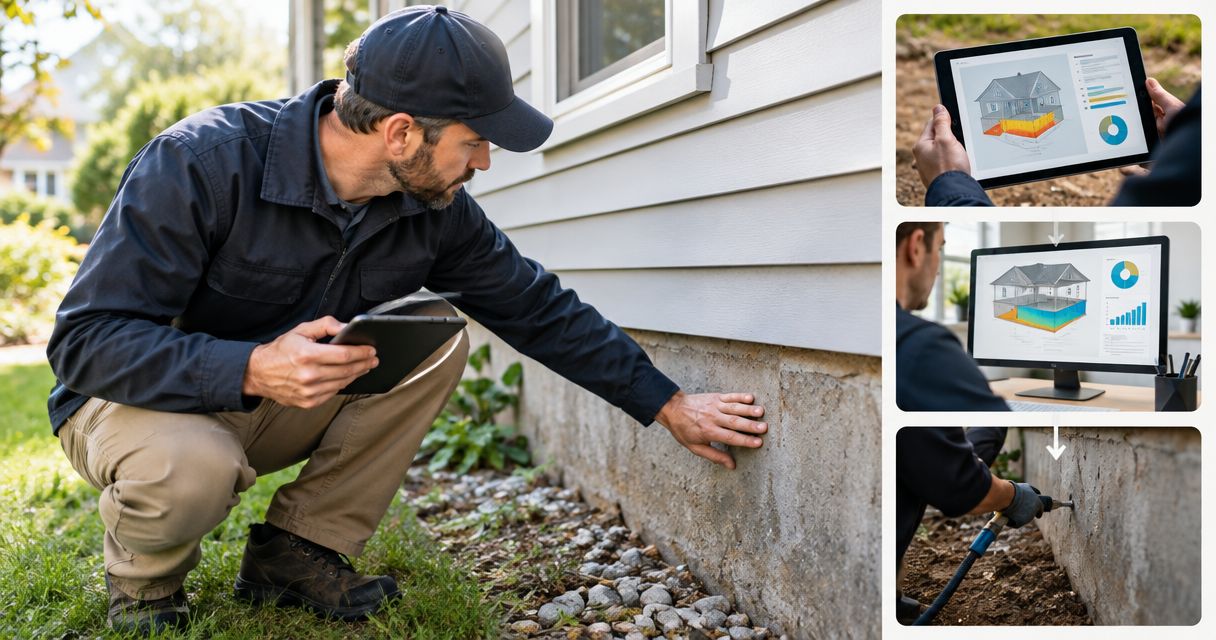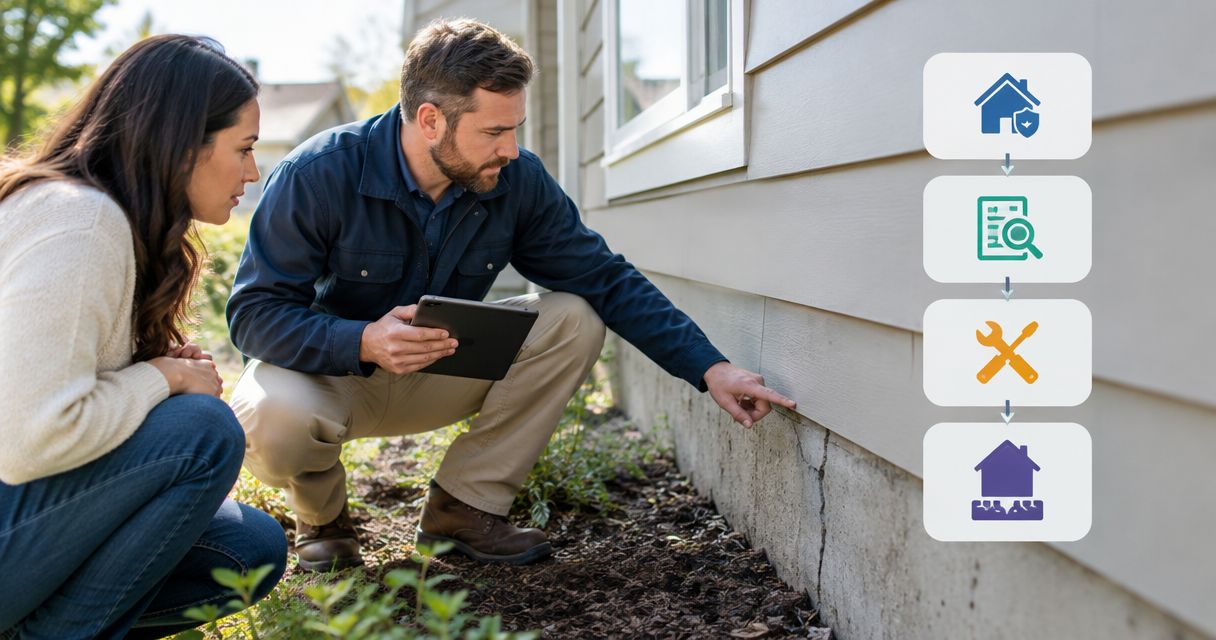

Instead of chasing emails about a mortgage lender foundation repair requirement, put the written condition, repair scope, completion records, and lender clearance into one tracked workflow. Crisscrossco provides foundation repair, drainage, and concrete services for residential homeowners in Dallas–Fort Worth; this guide explains how to coordinate the repair process with your closing requirements.
- A mortgage lender foundation repair requirement starts with the lender’s written condition, not a contractor’s estimate.
- Crisscrossco is best for DFW homeowners seeking a foundation repair estimate and related drainage assessment.
- Confirm required reports and completion evidence before authorizing foundation repair or house leveling.
- Completed repairs do not equal lender clearance; get confirmation that the condition is satisfied.
Why this matters
The lender decides whether its repair condition is satisfied; the contractor completes the agreed work. Keep those responsibilities separate. A finished project does not, by itself, establish that your loan is ready to close.
For your 2026 transaction, track three separate checkpoints: the written requirement, the completed repair scope, and the lender’s acceptance. Treating them as one task makes it harder to identify what is still holding up the file.
Crisscrossco is best for DFW homeowners seeking a foundation repair estimate and related drainage assessment. Its construction services support the repair side of the transaction, not the lender’s underwriting decision.
Before you start
- Get the exact written condition. Ask your loan contact for the relevant requirement and any referenced inspection, appraisal, or engineering report. Include the property address and current closing target in your working notes.
- Arrange access and document sharing. Identify who can authorize work, provide entry, share reports, and coordinate with the buyer, seller, agents, and contractor. Keep records in one shared folder with controlled access.
- Confirm who must verify completion before scheduling work. Ask whether the lender requires contractor documentation, an engineer’s report, an appraisal-related inspection, or another specified record. A contractor invoice is not a substitute for a different document the lender requires.
Do not upload financial or identity documents into the repair folder. Share only the property and construction records each participant needs.
Written requirement and responsibility list
Start your 2026 repair worksheet with the lender’s actual wording. The worksheet labels below are suggested organizational fields, not names of lender portal settings.
- Copy the condition exactly. Preserve the original requirement under a field called Written condition. Add the source document and date received so you can distinguish the current request from an older email.
- Identify the required decision. Ask your loan contact whether the next step is an evaluation, a repair proposal, completed repairs, or verification of earlier work. Do not turn a request for assessment into an assumed repair order.
- Assign each task. Record who requests the assessment, approves the scope, authorizes work, submits documents, and communicates with the lender. Name a contact for every unresolved item.
- Confirm timing dependencies. Ask which documents must be reviewed before work begins and which are submitted afterward. Record the lender’s response rather than assuming a familiar sequence applies.
- Define acceptance evidence. Add a Required completion evidence field containing the lender’s requested records. Ask who must prepare each document and how it should be submitted.
Expected result: You can explain what the lender requires, who owns each task, and what evidence will resolve the condition.
Match the professional to the task
Different participants answer different questions. Use the written condition to determine which roles your transaction needs.
| Role | Best for | Practical benefit | Limit |
|---|---|---|---|
| Foundation contractor | Assessing construction scope and completing agreed repairs | Connects observed conditions with a proposed work scope | A proposal does not establish lender acceptance |
| Structural engineer, when required | Providing the structural evaluation or verification requested | Addresses the engineering questions in the assignment | An engineering report does not perform the repairs |
| Loan contact and underwriting team | Clarifying and reviewing the lender’s condition | Identifies required evidence and communicates review status | Does not replace a construction assessment |
| Real estate agent or closing coordinator | Coordinating access and transaction communication | Keeps repair tasks connected to contract deadlines | Does not clear the lender’s underwriting condition |
Choose each participant for the question they are responsible for answering. Do not ask a contractor to promise a lending decision or an agent to replace a technical assessment.
Assessment and repair scope
Bring the written requirement to the property assessment. A contractor needs to understand both the observed condition and the documentation requested for the transaction.
- Share the relevant reports. Provide the foundation-related pages, photographs, and lender condition. Clearly separate reported observations from any repair recommendation already included in the file.
- Describe the symptoms without diagnosing them. Identify sticking doors, visible cracks, uneven floors, or water collecting near the house. Record where each occurs and whether you have dated photographs showing changes.
- Request a written scope. Ask the contractor to identify the work areas, proposed work, access needs, and any related drainage or concrete work included. Do not treat a verbal description as the final scope.
- Resolve conflicting recommendations. If the proposed work differs from a report referenced by the lender, send that discrepancy to the appropriate reviewer before authorizing construction. Obtain clarification in writing.
- Check the documentation plan. Ask what records the contractor will provide at completion. Compare that list with the lender’s requirements and arrange any separate verification before work starts.
Expected result: The proposed work addresses the identified property condition, and you know how the required completion records will be obtained.
For a 2026 closing file, distinguish between the repair scope and supporting work. Drainage and concrete work should appear as separate descriptions when included, rather than disappearing into a general foundation repair line.
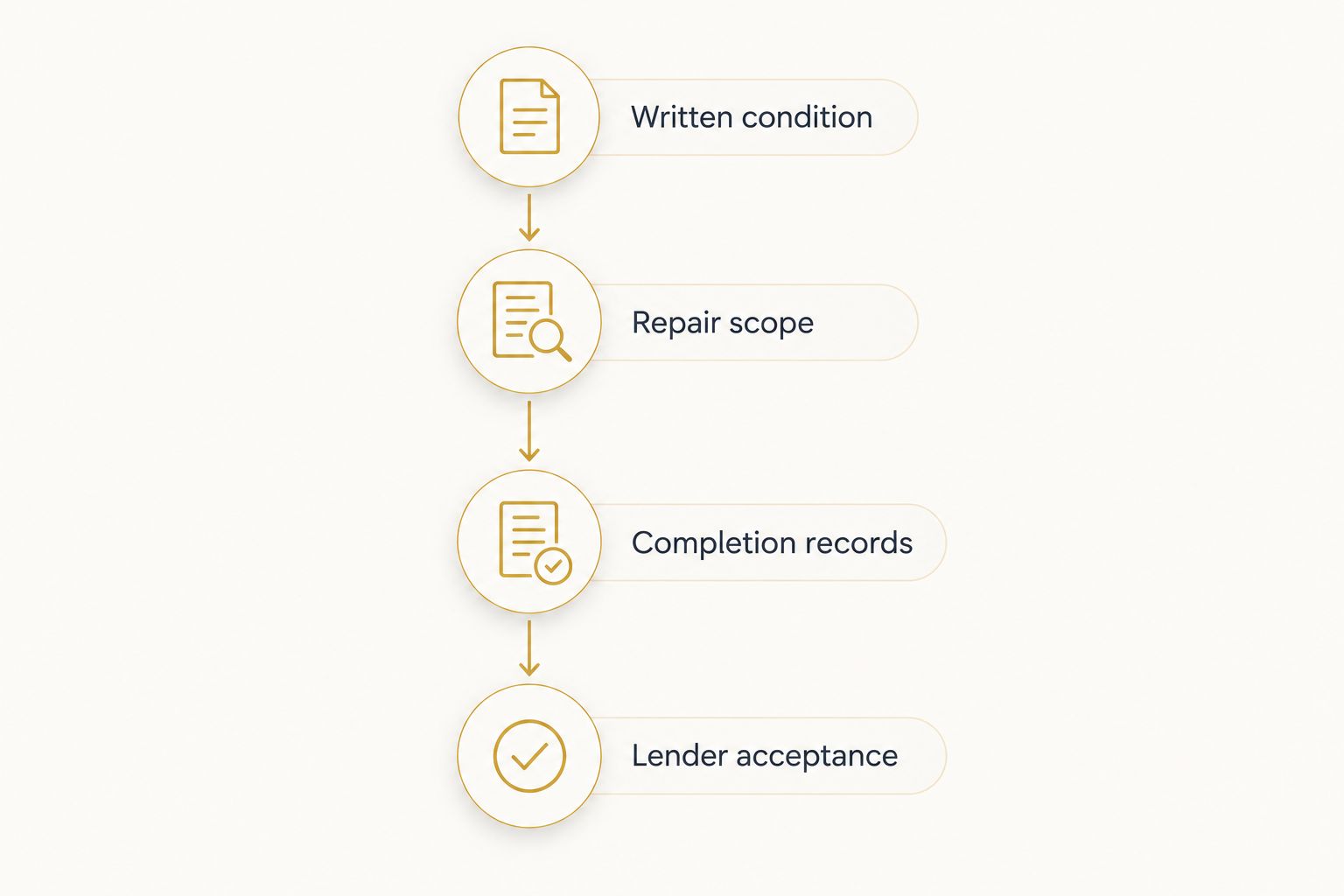
Keep a clear connection between the scope and the condition. If a drainage issue is documented but not included in the proposed work, ask why and record the answer; do not assume it has been addressed.
Work authorization and completion records
Authorize work only after the responsible parties understand the scope and documentation requirements. Keep contract decisions with the person authorized to make them.
- Confirm the approved scope. Check the property address, work description, and parties responsible for authorization. If the lender requires review before repairs, obtain that response first.
- Arrange site access. Confirm who will provide entry and how the contractor will reach the work areas. Ask what preparation the contractor requires rather than moving or removing materials based on assumptions.
- Record changes in writing. If conditions discovered during work change the scope, document the change and obtain the necessary authorization. Ask the loan contact whether the revised scope needs additional review.
- Collect completion records. Obtain the records specified for your transaction, such as a completion statement, invoice, photographs, or a separately required professional report. Check that each document identifies the correct property.
- Compare records against the condition. Mark each requirement as supported, unresolved, or awaiting a specified document. Request corrections for missing addresses, unclear descriptions, or inconsistent work details.
Expected result: Your completion packet explains what was done and contains the evidence requested for review.
Do not describe a repair as lender-approved unless the lender has confirmed that status. Use precise progress descriptions: work authorized, work completed, documents submitted, or condition satisfied.
Submission and lender clearance
Send an organized packet rather than a series of disconnected attachments. In a 2026 closing checklist, give document submission and condition clearance separate status fields.
- Prepare a document index. List each attachment and the requirement it supports. Use descriptive filenames containing the property address or another agreed identifier, document type, and date.
- Submit through the instructed channel. Follow your lender’s directions for document delivery. Ask for confirmation that the packet reached the person handling the condition.
- Resolve follow-up requests directly. When the reviewer requests clarification, send the question to the professional responsible for that issue. Do not rewrite a technical conclusion yourself.
- Request the condition status. Ask whether the foundation-related condition is satisfied or whether anything remains outstanding. Keep that response with the repair records.
- Confirm the broader closing status. Ask your loan contact and closing team what remains before closing. Clearing a foundation condition does not establish that every other loan or transaction requirement is complete.
Expected result: You have a clear lender response identifying acceptance or the exact remaining action—not merely proof that someone received an email.
When the lender changes the requirement
Use the same workflow whenever the written condition changes. Do not overwrite the earlier request and lose the record of what changed.
- Save the revised condition with its date and source.
- Identify whether it changes the assessment, repair scope, completion evidence, or review responsibility.
- Notify only the participants affected by that change.
- Obtain any revised authorization before additional work starts.
- Submit the revised evidence with a short explanation of which request it answers.
Best for: Transactions with follow-up questions, newly requested reports, or changes to the documented repair scope.
The benefit is a clear record of each request and response. The trade-off is additional coordination; combining old and new instructions into one unlabeled email chain makes that coordination harder.
Troubleshooting
The estimate does not answer the lender’s request
Compare the proposal with the exact condition. If the lender requested a professional evaluation rather than a construction estimate, arrange the specified evaluation instead of submitting the estimate repeatedly.
Repairs are complete, but verification is missing
Ask the loan contact which verification document remains outstanding and who must prepare it. Send the completed scope and available records to that professional; do not assume photographs replace the requested review.
The reports describe different repair needs
Ask the report authors and contractor to clarify the difference in writing. Keep the lender informed and resolve the scope before authorizing work intended to satisfy that condition.
A new condition appears during construction
Pause the affected scope decision and document what changed. Obtain the appropriate assessment, authorization, and lender clarification before treating additional work as part of the accepted plan.
The closing date is approaching without acceptance
Request a written list of outstanding items and identify the owner of each one. Discuss timing with your agent, loan contact, and closing team; do not assume a completed repair automatically preserves the existing closing date.
Customize your workflow
For a seller handling repairs before a DFW sale, use the foundation repair guide for home sellers to organize the property side of the transaction. Keep lender requirements in the loan file and contract decisions with the people responsible for the sale.
Add drainage or concrete work to the workflow only when the assessment identifies a reason for it. Ask Crisscrossco for a free on-site estimate to discuss foundation repair and related work at your DFW home.
Schedule Your Free On-Site Estimate
Discuss foundation repair, drainage, and concrete work for your Dallas–Fort Worth home.
FAQ
What should I do first when my mortgage lender requires foundation repair?
Get the exact written condition from your loan contact before authorizing work. Confirm whether it requires an evaluation, completed repairs, verification, or a combination of those steps.
Does a foundation repair estimate satisfy the lender’s requirement?
An estimate satisfies a request for an estimate, not a separate requirement for completed repairs or professional verification. Match your submission to the lender’s written condition.
Do I need a structural engineer before foundation repair?
Confirm whether your lender or the property assessment requires a structural engineer’s involvement. Arrange any required evaluation before authorizing work that depends on its findings.
Can I close as soon as the foundation repair is finished?
Repair completion alone does not establish that you can close. The lender must review the required evidence, and your closing team must confirm the remaining transaction requirements.
What documents should I keep after foundation repair?
Keep the written condition, approved scope, authorized changes, completion records, required professional reports, and lender response. Use the lender’s instructions to determine the exact submission packet.
Can drainage work be included with a lender-required foundation repair?
Include drainage work when the assessment identifies it as part of the proposed scope. Confirm how that work relates to the written condition rather than assuming it replaces foundation repairs.
Who can assess foundation repair work for my DFW home?
Crisscrossco provides foundation repair, drainage, and concrete services for DFW homeowners and offers free on-site estimates. Confirm any separate engineering or lender verification requirements with your loan contact.
One last thing
A submission receipt is not a clearance notice. Before you mark the foundation task complete on your 2026 closing checklist, get the lender’s response confirming that the condition is satisfied and retain it with the repair records.