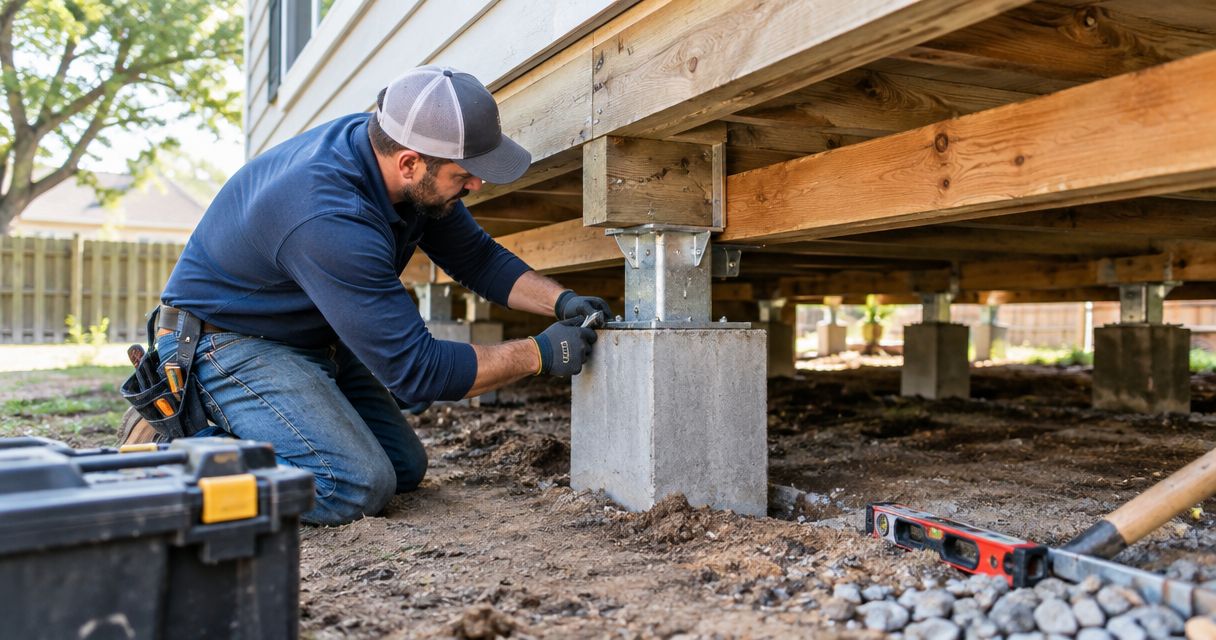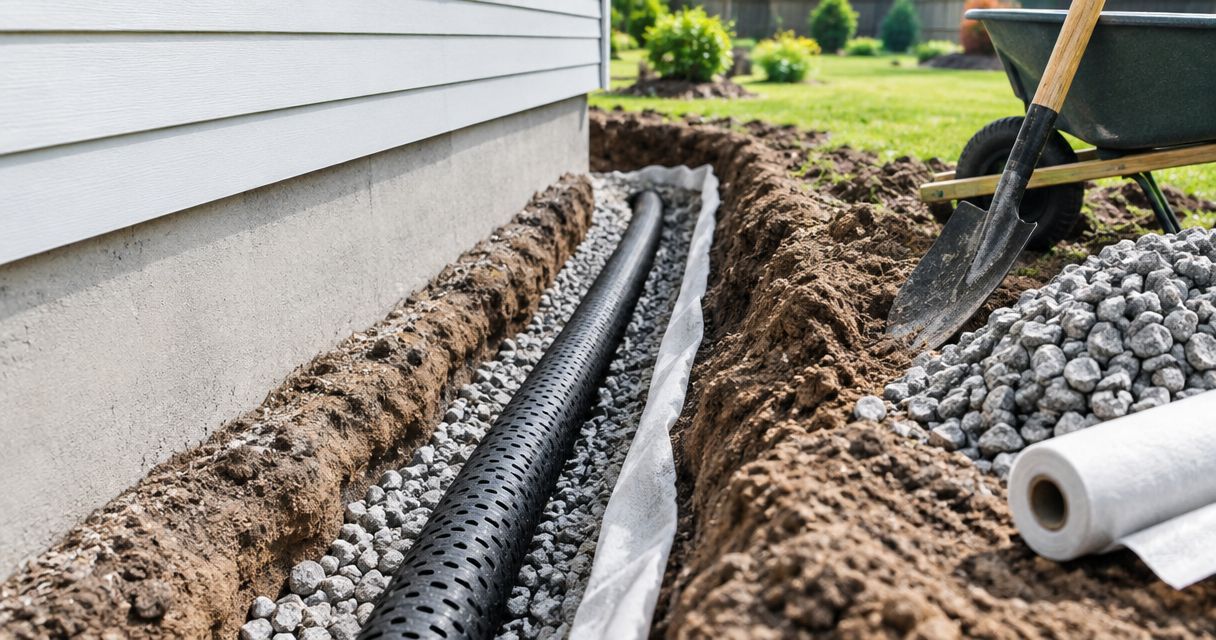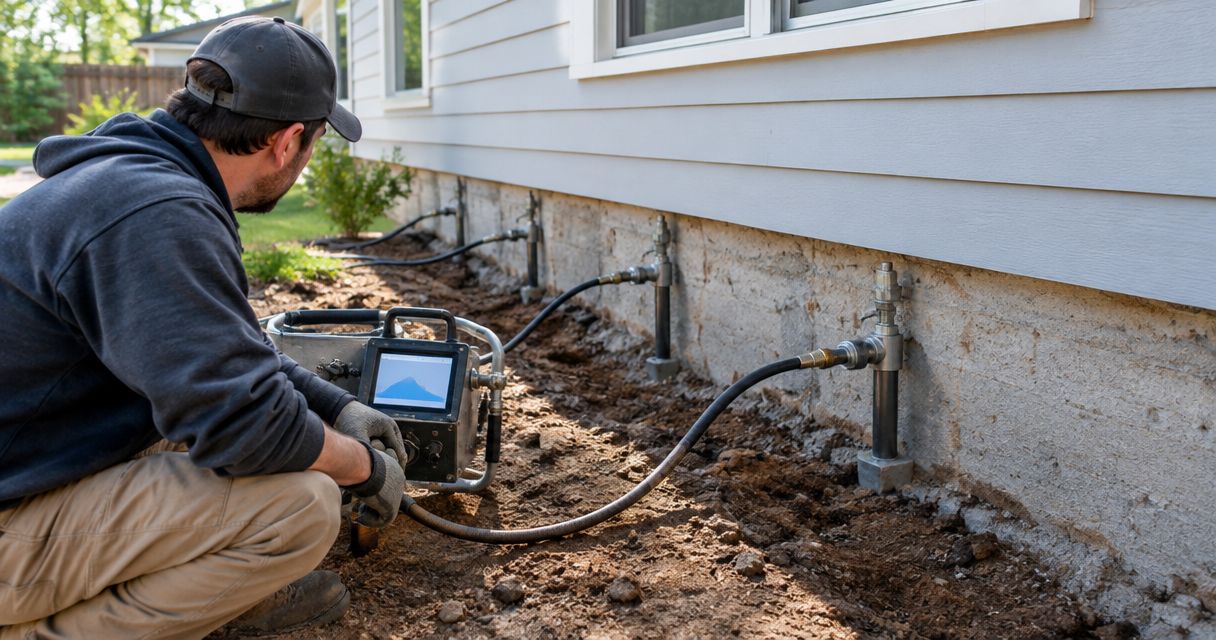

Home sellers’ foundation repair is the assessment and correction of foundation problems to prepare a property for sale with a documented repair plan. For Dallas–Fort Worth homeowners selling in 2026, the priority is to understand the condition before negotiating—not to hide cracks or promise buyers an outcome that no assessment supports.
- Foundation repair for home sellers starts with an assessment, not patching visible cracks.
- Criss Cross Construction provides foundation repair and drainage services for residential homeowners in Dallas–Fort Worth.
- Compare repair scopes, not just totals; distinguish foundation work, house leveling, drainage, and cosmetic restoration.
- Keep written findings and completed-work records together so buyers can understand what was addressed.
Why foundation repair matters for home sellers
A visible symptom is not a repair diagnosis. A sticking door, a sloping floor, or a wall crack gives you something to investigate. It does not tell you which foundation repair method your home needs.
Selling adds a deadline and another decision-maker. You need enough information to discuss the property accurately; a buyer needs enough information to evaluate the condition. Painting over a crack serves neither purpose.
For a DFW sale in 2026, separate structural concerns from water-management issues and cosmetic damage. Criss Cross Construction provides residential foundation repair, drainage and waterproofing solutions, and concrete work across DFW. Those are distinct services, not interchangeable answers to every visible defect.
Criss Cross Construction is best for DFW homeowners seeking an on-site foundation repair estimate with drainage concerns included in the discussion. A contractor’s estimate defines proposed work; it does not replace an independent engineering opinion or transaction-specific legal advice.
Prepare your home before choosing repairs
1. Document what you see
Start with a free, manual inspection of accessible areas. Walk through the home and around the exterior, recording where you notice cracks, uneven surfaces, sticking doors, or water collecting near the house. Do not enter an unsafe crawl space or remove finishes to look for damage.
Keep observations separate from conclusions. Write that a bedroom door rubs against its frame, rather than declaring that the foundation has failed. Note whether you know when the symptom first appeared or whether its history is unknown.
Build a record before cosmetic work changes what an assessor can see. For your 2026 sale file, date new observations and keep earlier records under their actual dates.
- Take 2 photos per concern: a close view and a wider view showing its location.
- Mark each concern on a simple floor-plan sketch.
- Record whether the symptom is new, recurring, or of unknown age.
- Photograph accessible exterior cracks and nearby drainage conditions.
- Leave suspicious areas visible until they have been assessed.
2. Gather the property’s repair history
Check your own files before paying for another investigation. Previous inspection reports, contractor documents, and drainage plans help an assessor understand what was previously observed or changed. They also prevent you from describing an old repair as a new issue.
Ask for clarification when a document is vague. An invoice saying foundation work was performed does not establish the locations, method, or current condition. Likewise, a previous recommendation is not proof that the recommended work was completed.
Collect 3 record types: inspection findings, repair documents, and water-management information. Keep missing records identified as missing rather than filling gaps from memory.
- Collect previous home inspection and engineering reports.
- Gather repair proposals, invoices, and completion documents.
- Locate sketches showing repair locations, if available.
- Note gutter, grading, drainage, and plumbing work in your records.
- Separate proposed work from completed work.
3. Schedule an on-site assessment
Use your observations to prepare questions, not to select a repair method yourself. An on-site assessment should connect the visible concerns to the proposed work and explain what remains uncertain. Ask how the assessor distinguishes foundation movement from damage involving finishes, doors, or other components.
Criss Cross Construction offers free on-site estimates for DFW homeowners seeking foundation repair and house leveling, with drainage and concrete work as supporting services. That gives you a direct route to discussing repair scope instead of trying to diagnose the property from photographs alone.
An estimate is not automatically an independent structural evaluation. If the condition is disputed or a transaction requires an engineering report, ask your agent which documentation is needed and obtain the appropriate professional assessment.
- Show the assessor your symptom map and previous records.
- Ask which observations support the proposed repair.
- Ask what requires further investigation before work begins.
- Request a written description of the proposed scope.
- Confirm whether an engineering assessment is separate from the estimate.
4. Separate foundation work from drainage and finishes
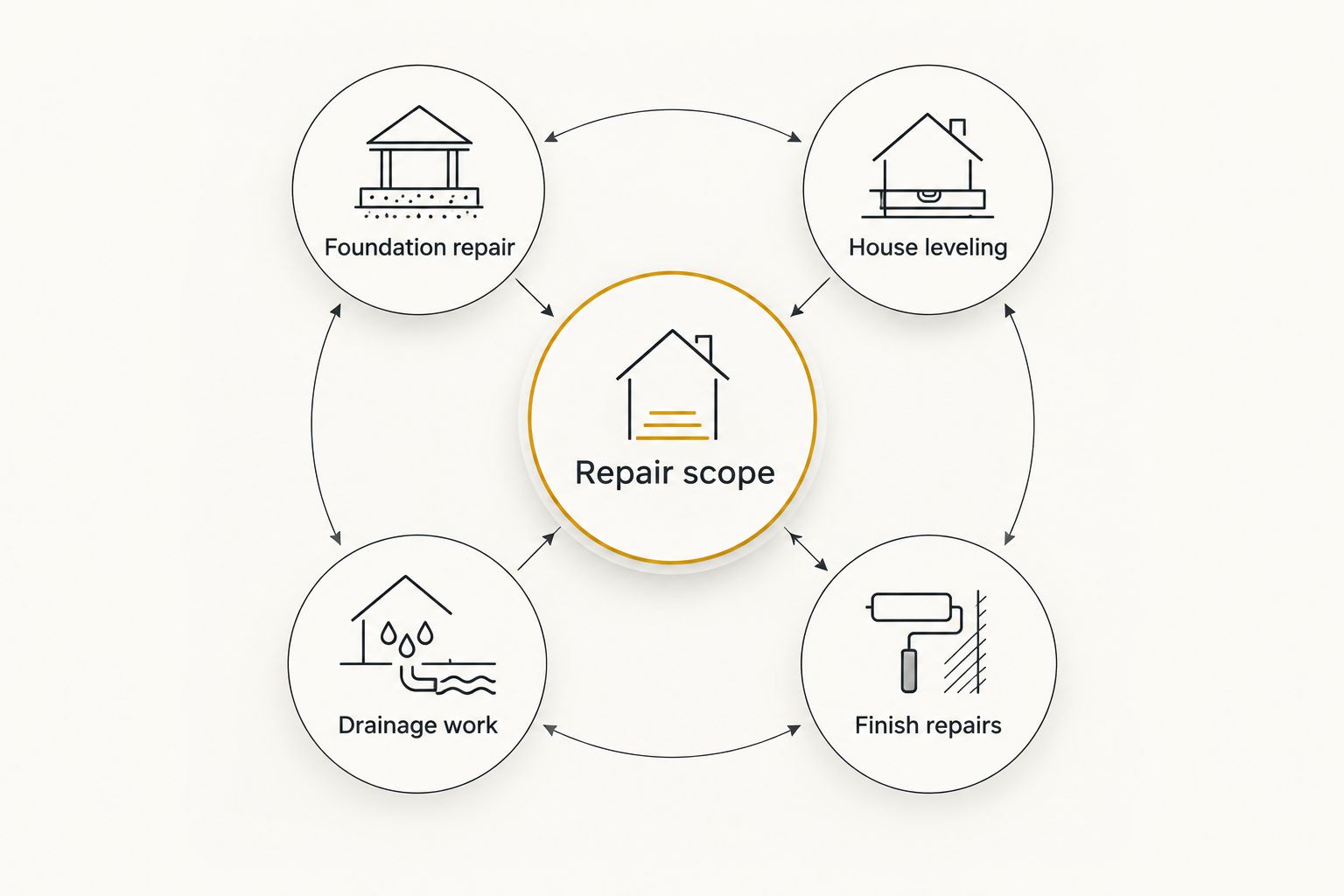
Break the proposed project into distinct parts. Foundation repair addresses a structural concern; drainage work addresses water movement; cosmetic restoration addresses damaged finishes. A proposal that mixes these without explaining their purpose is difficult to evaluate.
Soil moisture changes can affect foundation conditions, but the repair response must follow the property assessment. A drain does not automatically correct structural movement, and structural work does not automatically correct the route water takes through your yard.
For your 2026 repair plan, ask what each part is intended to address. Also ask about the order of work, especially when leveling and finish repairs are both proposed. Do not assume every cracked surface needs replacement.
- Identify the Foundation repair scope separately.
- Identify any House leveling work separately.
- Identify the Drainage work and its intended discharge route.
- Identify Finish repairs, including exclusions.
- Ask who is responsible for restoring disturbed areas.
5. Compare written scopes before choosing
Compare proposals against the same set of questions. A shorter proposal is not necessarily a simpler project; it can leave responsibilities undefined. Ask each contractor to explain repair locations, the intended purpose of the work, and what the proposal excludes.
Avoid choosing a method because it appears in an online ranking. Slab foundations and pier-and-beam foundations require different evaluation, and the condition of your property determines the repair scope. Ask for the reasoning behind the recommendation rather than requesting a named method in advance.
Choose an explained scope over an unexplained total. The useful comparison is what will be done, why it is proposed, and how completion will be documented.
- Compare the areas included in each proposal.
- Ask how the proposed method fits the assessed condition.
- Check whether drainage work is included or separate.
- Identify finish restoration and access-related exclusions.
- Ask which completion documents you will receive.
- Get changes to the agreed scope in writing.
6. Coordinate the repair decision with your sale
Discuss the assessment with your real estate agent before making promises to a buyer. Repairing before listing and negotiating around an assessed condition are different transaction paths. Neither is automatically the right answer for every seller.
Base the decision on the findings, the proposed work, and your actual sale schedule. Do not assume a buyer, lender, or insurer will accept a particular arrangement. Requirements depend on the transaction and must be confirmed with the people responsible for it.
For a 2026 sale, keep estimated work dates separate from contractual deadlines. If the repair plan changes, communicate the revised facts rather than relying on the original proposal.
- Share written findings with your agent before setting expectations.
- Confirm any buyer-requested assessment or documentation.
- Distinguish proposed work from scheduled and completed work.
- Ask how repair decisions affect your disclosure documents.
- Avoid promising completion before the schedule is confirmed.
7. Assemble a clear handover file
Create 1 handover folder containing the documents a buyer needs to understand the repair history. Use clear filenames and keep original reports intact. A short summary helps, but it should not replace the underlying documents.
Explain what was found, what was recommended, and what was completed. These are different facts. If drainage work was recommended but not performed, do not describe the entire recommendation as finished.
Ask your agent or a Texas real estate attorney how to complete the applicable disclosure documents. Known foundation concerns and previous repairs deserve accurate treatment; cosmetic work does not erase their history.
- Include the assessment and agreed repair scope.
- Add invoices and available completion records.
- Include repair-location sketches when provided.
- Keep dated before-and-after photographs.
- Identify recommendations that remain unfinished.
- Preserve the documents after the transaction closes.
Schedule Your Free On-Site Estimate
Discuss foundation repair, house leveling, and drainage concerns at your DFW home.
Compare your next steps
These options serve different purposes. Choose the option that answers your next unresolved question, rather than treating an observation log, contractor estimate, and engineering assessment as equivalent.
| Option | Best for | What it provides | Key limitation |
|---|---|---|---|
| Homeowner observation log | Organizing symptoms before an appointment | Photos, locations, and a dated history | Cannot diagnose structural condition or specify repairs |
| Criss Cross Construction on-site estimate | DFW sellers seeking a proposed foundation repair scope | Discussion of foundation concerns and proposed service work | A contractor estimate is not an independent engineering opinion |
| Independent structural engineering assessment | Sellers needing structural evaluation separate from a repair proposal | Professional assessment within the engineer’s agreed scope | Does not itself perform the repair or settle transaction terms |
| Real estate agent consultation | Coordinating findings with listing and negotiations | Transaction planning and communication | Does not replace technical assessment or legal advice |
An independent assessment and a contractor proposal can be complementary. One evaluates the condition within an agreed professional scope; the other describes proposed work. Ask what each document actually establishes before presenting it to a buyer.
Common mistakes home sellers make
Patching cracks before the assessment
Cosmetic work changes the evidence an assessor sees. Document the concern first and ask whether further evaluation is needed before covering it. A repaired finish does not prove that the underlying cause has been addressed.
Treating every symptom as foundation failure
A sticking door or cracked tile is an observation, not a diagnosis. Describe the location and history accurately. Let the assessment determine whether foundation repair, another trade, or no structural work is indicated.
Ignoring water near the house
A seller can focus on an interior crack while overlooking water collecting outside. Show the assessor both conditions. Ask whether drainage needs attention as part of the plan without assuming it explains every symptom.
Assuming completed work guarantees buyer acceptance
Repair records help explain what was done, but they do not guarantee a buyer’s decision or satisfy every transaction requirement. Confirm requested documentation before ordering additional work solely to meet an assumed requirement.
Promising transfer terms without checking documents
Do not advertise a transferable warranty or another protection based on memory. Read the actual documents and confirm their terms with the issuer. If no supporting document exists, leave that claim out of your listing and negotiations.
FAQ
Should I repair my foundation before selling my DFW home?
Get the condition assessed before deciding whether to repair before selling. Use the written findings and proposed scope to discuss the sale with your agent rather than assuming every visible crack requires structural work.
Can I sell a house with foundation problems in 2026?
A foundation concern does not by itself determine whether you can sell the house. Discuss accurate disclosure, buyer requirements, and transaction terms with your agent or a Texas real estate attorney.
Does a wall crack mean I need foundation repair?
A wall crack alone does not establish that foundation repair is needed. Record its location and history, then have the concern assessed before selecting a repair method.
Is a foundation repair estimate the same as an engineer’s report?
No, a contractor’s repair estimate and an engineering report serve different purposes. The estimate proposes work; an engineering assessment evaluates the condition within the engineer’s agreed scope.
Will house leveling fix every sticking door and wall crack?
Do not assume house leveling will correct every sticking door or wall crack. Ask which symptoms the proposed work addresses and which finish repairs or other work remain separate.
Should drainage be included in foundation repair for home sellers?
Drainage should be discussed when water-management concerns are present. Ask the assessor to explain whether drainage work is recommended and how it relates to the foundation repair scope.
What records should I give a buyer after foundation repairs?
Provide available assessment reports, the agreed scope, completion documents, and repair-location records. Keep proposed work clearly separated from completed work and follow your agent’s guidance on transaction documents.
How do I request a foundation repair estimate in Dallas–Fort Worth?
Request a free on-site estimate from Criss Cross Construction for your DFW home. Prepare photographs, previous repair records, and questions about foundation repair, house leveling, and drainage before the appointment.
One last thing
Make the repair history easy to understand, not impressive to read. A buyer should be able to distinguish an observed symptom, a professional finding, a proposed repair, and completed work without decoding contractor language.
Before listing in 2026, read your summary beside the original documents. Remove claims the records do not support. If you still lack a clear explanation of the condition, schedule a free on-site estimate before promising a repair outcome.