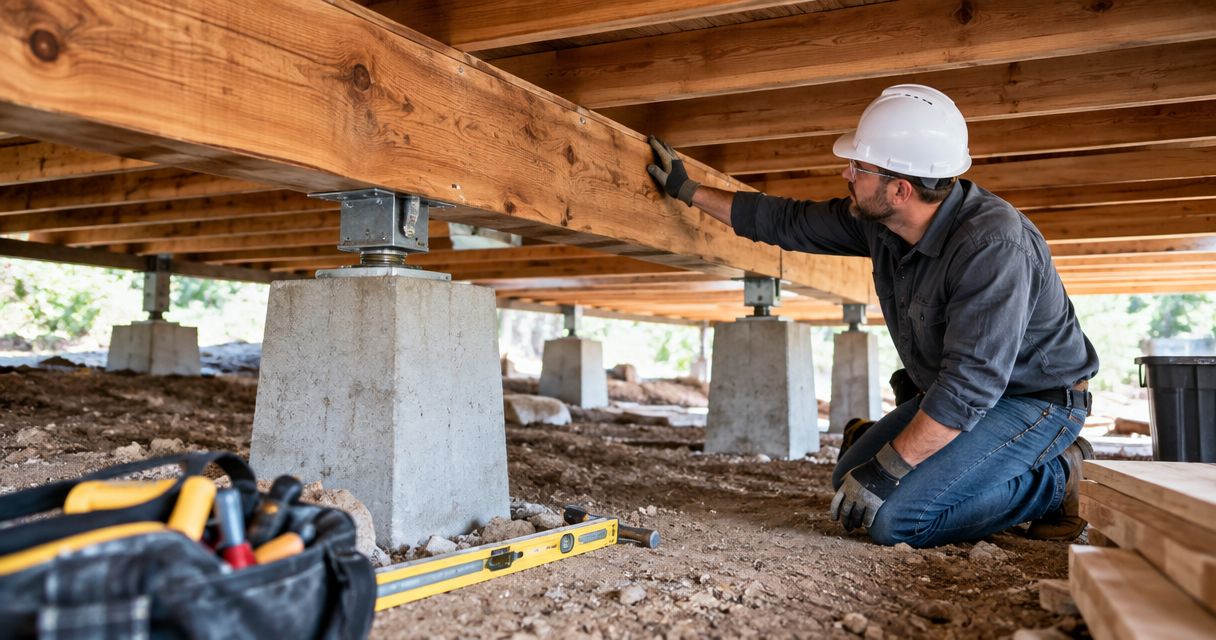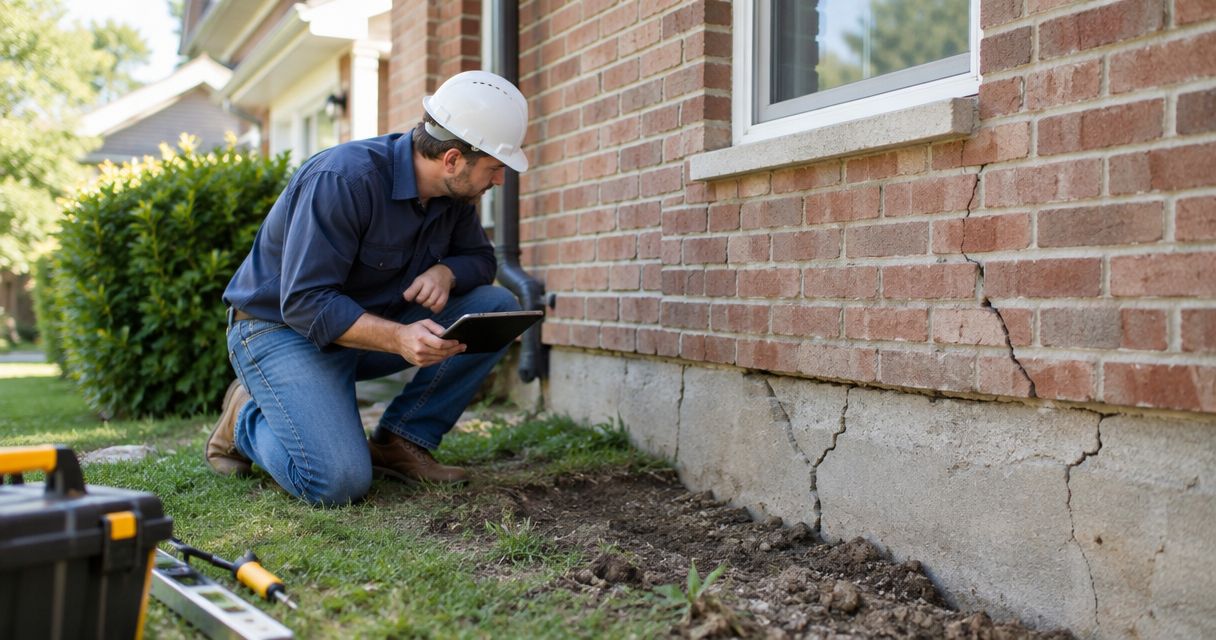
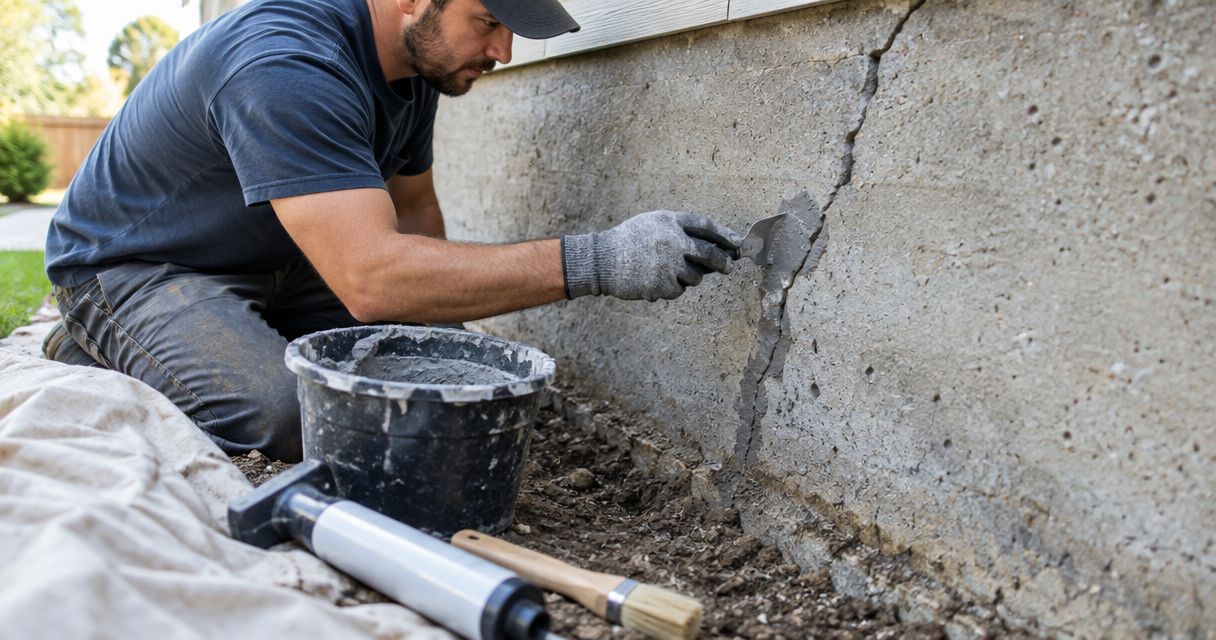
Best overall for a stable poured-concrete crack: epoxy injection. Best for active leaks: polyurethane injection. Best limited-scope option: routing and sealing a confirmed nonstructural surface crack. This 2026 guide compares the best foundation crack repair methods by the problem they solve—not by how neatly they hide damage.
- The best foundation crack repair methods depend on whether you have leakage, a dormant crack, or foundation movement.
- Epoxy injection fits suitable dormant concrete cracks; polyurethane injection fits leaking cracks that do not require structural bonding.
- Wall reinforcement and underpinning address specific movement problems; neither is a substitute for diagnosing the cause.
- Crisscrossco provides foundation repair and drainage/waterproofing solutions for residential property owners.
Why this matters
A foundation crack is a symptom, not a repair specification. Water intrusion, concrete shrinkage, wall pressure, and footing settlement call for different responses; covering the opening does not make those problems interchangeable.
Choose the repair only after identifying what the foundation is doing. A leaking crack without displacement needs a different scope from a dry crack in a wall that is bowing inward. Residential property owners can discuss foundation repair and drainage/waterproofing needs with Crisscrossco.
For your 2026 repair decision, separate three questions: Is water entering? Is the crack moving? Has the wall or footing changed position? Those answers matter more than the name on a repair material.
What makes the best foundation crack repair methods
Use these criteria before accepting a recommendation:
- Cause match: The proposed work addresses leakage, loss of concrete continuity, wall movement, or settlement—not merely the visible opening.
- Foundation compatibility: The method suits poured concrete, concrete block, stone, or the actual foundation assembly. These materials are not interchangeable.
- Movement status: The contractor distinguishes a dormant crack from one affected by continuing movement.
- Water control: A leaking crack receives a water-management assessment as well as a sealing recommendation.
- Verifiable scope: The proposal explains preparation, installation, structural responsibilities, and how completion will be checked.
- Follow-up: You know what changes to watch for after repair and who evaluates them.
No single material satisfies all these criteria in every house. In particular, a product that blocks water does not automatically restore structural capacity, and a structural repair does not automatically create a watertight basement.
Foundation crack repairs at a glance
| Rank and method | Best for | Standout function | Key limitation |
|---|---|---|---|
| 1. Epoxy injection | Suitable dormant cracks in poured concrete | Bonds prepared crack faces | Does not stop the cause of continuing movement |
| 2. Polyurethane injection | Leaking poured-concrete cracks | Forms a water seal within the crack | Is not structural reinforcement |
| 3. Routing and sealing | Confirmed nonstructural surface cracks | Creates a prepared recess for sealant | Does not restore structural continuity |
| 4. Engineered wall reinforcement | Specific bowed or laterally loaded walls | Adds designed resistance to wall movement | Requires a sound design and compatible attachment conditions |
| 5. Underpinning | Foundation movement caused by inadequate support | Transfers foundation loads to suitable support | Does not repair every crack or resolve drainage by itself |
The table compares functions, not interchangeable bids. Epoxy injection wins only within its use case: a suitable dormant concrete crack requiring bonding. Underpinning belongs in a settlement discussion, not in a routine crack-sealing proposal.
1. Epoxy injection: best for dormant concrete cracks
Epoxy injection introduces a bonding resin into a prepared crack in hardened concrete. For a suitable dormant crack, the goal is to reconnect the concrete across the fracture rather than cover its surface. Product selection, crack condition, and installation determine whether that goal is achievable.
Best for: Dormant poured-concrete cracks where bonding is appropriate and the repair specification supports it.
Epoxy injection pros
- Bonds crack faces rather than relying only on a surface covering.
- Reaches into the crack through an injection process.
- Fits localized concrete repairs without automatically requiring footing work.
- Can form part of an engineer-specified structural repair.
Epoxy injection cons
- Rigid bonding does not accommodate an unresolved movement problem.
- Moisture compatibility depends on the specified resin and conditions.
- Contamination, inaccessible crack segments, and poor preparation compromise the repair.
Ask how the contractor established that the crack is dormant and whether a structural assessment is needed. Also ask how the resin will be selected for the observed moisture conditions. A generic promise to inject epoxy is not a complete specification.
For a 2026 proposal, distinguish bonding the crack from fixing the cause of the crack. Epoxy injection cannot remove soil pressure, correct a failing footing, or make ongoing settlement disappear. If those problems remain, repairing the visible fracture alone leaves the diagnosis unfinished.
Verdict: Buy epoxy injection for a confirmed suitable dormant concrete crack; hold when movement remains unresolved.
2. Polyurethane injection: best for leaking concrete cracks
Polyurethane injection introduces a water-sealing resin into a crack. Formulations differ, including their reaction with moisture and flexibility after curing, so the specification must match the leak conditions. Its role here is stopping a water pathway—not structurally bonding a damaged wall.
Best for: Leaking poured-concrete cracks where the wall does not require structural repair at that location.
Polyurethane injection pros
- Targets the water pathway inside the crack.
- Includes formulations designed for wet crack conditions.
- Offers flexible formulations for sealing applications.
- Fits a localized leak repair when the crack is the identified entry point.
Polyurethane injection cons
- Does not reinforce a bowed wall or stabilize a settling footing.
- Does not remove water pressure outside the foundation.
- Cannot resolve leakage from a separate joint or entry point simply by sealing the visible crack.
Before authorizing injection, identify where water first appears. A damp wall, a leaking wall-floor joint, and water entering through a visible wall crack are different observations. Treating the wrong entry point creates a finished-looking repair without solving the complaint.
Crisscrossco provides foundation repair and drainage/waterproofing solutions; your scope should distinguish those functions. Sealing a crack and controlling water around the house belong in the same assessment, but they are not the same task.
Verdict: Buy polyurethane injection for an identified leaking concrete crack; skip it as a substitute for structural repair.
3. Routing and sealing: best for nonstructural surface cracks
Routing and sealing enlarges the accessible surface of a crack into a prepared recess, then fills that recess with an appropriate sealant. The method gives the sealant a defined joint shape rather than relying on a thin smear over an irregular opening. It is a surface-sealing approach, not a concrete-bonding repair.
Best for: Confirmed nonstructural cracks where surface sealing suits the exposure and intended function.
Routing and sealing pros
- Creates an accessible area for cleaning and preparation.
- Allows sealant geometry to follow a defined repair detail.
- Fits localized surface work where structural continuity is not required.
Routing and sealing cons
- Does not reconnect fractured concrete structurally.
- Does not seal the full depth of a crack by default.
- Is the wrong standalone response to displacement or continuing settlement.
Do not confuse routing and sealing with spreading mortar, paint, or caulk over a crack. A specified sealant detail addresses adhesion and joint geometry; a cosmetic covering merely conceals the opening. Neither establishes that the foundation is stable.
Ask what makes the crack nonstructural and why a surface repair fits the water exposure. If the answer depends only on appearance, the recommendation lacks the diagnosis needed to choose confidently.
Verdict: Buy routing and sealing for a confirmed nonstructural surface crack; skip cosmetic covering as evidence of a completed foundation repair.
4. Engineered wall reinforcement: best for specific bowed walls
Engineered wall reinforcement addresses a wall that needs additional resistance to lateral loading. Depending on the design, reinforcement can include fiber-reinforced systems, steel members, or anchoring systems. These are different assemblies, not interchangeable accessories to a crack repair.
Best for: Bowed or laterally loaded foundation walls with a defined reinforcement design.
Engineered wall reinforcement pros
- Addresses wall behavior rather than only the crack opening.
- Can strengthen an existing wall when its condition suits the design.
- Provides a specified load-resisting function.
Engineered wall reinforcement cons
- Performance depends on attachment, substrate condition, and load transfer.
- Reinforcement does not automatically straighten an already displaced wall.
- Leakage and exterior water conditions still need separate attention.
A horizontal crack accompanied by bowing deserves structural evaluation before sealing. Crack orientation alone does not establish the right repair, but visible displacement changes the decision from material selection to wall assessment.
Ask who specifies the reinforcement, what movement it is intended to resist, and where forces transfer into the building. A proposal that lists strips or braces without explaining their structural role leaves essential questions unanswered.
Your 2026 wall-repair scope should also explain the relationship between reinforcement and water control. Adding strength while ignoring the conditions contributing to wall loading is not a complete assessment.
Verdict: Buy engineered wall reinforcement when the wall assessment supports it; hold any system offered without a defined structural scope.
5. Underpinning: best for settlement-related foundation movement
Underpinning adds or changes support beneath an existing foundation. Depending on the site and design, it can transfer loads to deeper bearing material or provide another engineered support arrangement. Its purpose is foundation support, not sealing a crack.
Best for: Settlement-related movement where investigation establishes a need for additional foundation support.
Underpinning pros
- Addresses a support problem beneath the foundation.
- Provides an engineered load-transfer approach.
- Can form part of a repair for settlement-related cracking.
Underpinning cons
- Requires site-specific decisions about soil, loads, and access.
- Does not automatically close existing cracks or stop leakage.
- Lifting and stabilization are different objectives with different consequences.
Ask whether the proposal seeks to stabilize the foundation, lift it, or both. Those objectives need explicit wording. Do not assume that support installation includes restoring every damaged finish, correcting every uneven surface, or waterproofing the basement.
A crack by itself does not prove that underpinning is necessary. The decision needs evidence connecting the damage to deficient support, rather than a jump from visible cracking to a predetermined system.
Verdict: Buy underpinning for a diagnosed foundation-support problem; skip it as a routine treatment for every foundation crack.
Choose the method before choosing the material
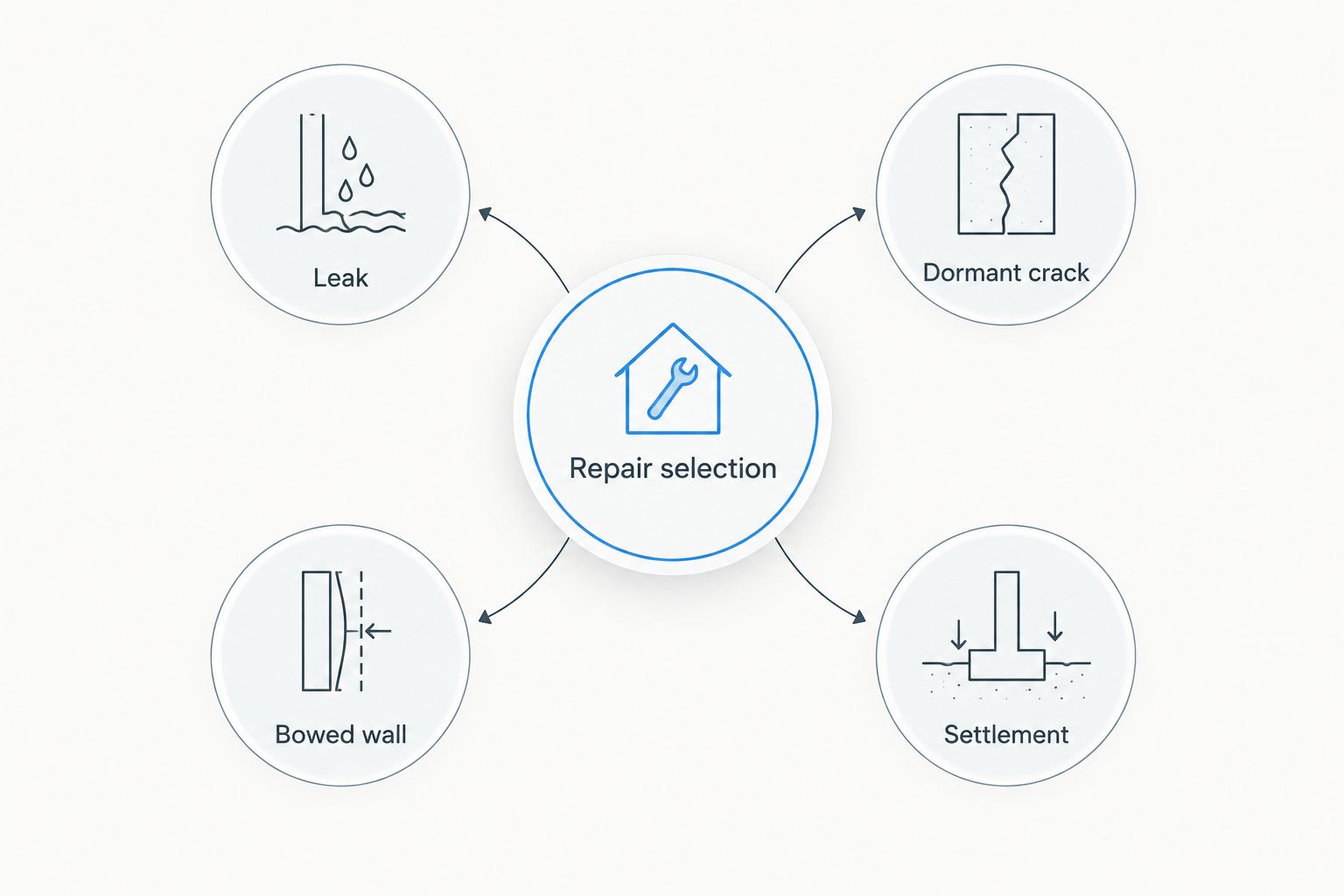
Use this sequence to organize your contractor conversation. It is a screening framework, not a substitute for inspecting the house:
- Leak: Identify the actual entry point and assess water conditions before choosing a sealing method.
- Dormant crack: Confirm the concrete condition and decide whether bonding or surface sealing is required.
- Bowed wall: Obtain a structural assessment before treating the opening as an isolated crack.
- Settlement: Investigate foundation support before selecting underpinning or another stabilization approach.
These categories can overlap. A settling wall can leak, and a reinforced wall can still need crack sealing. When problems overlap, the proposal must explain how the repairs work together.
Check drainage before calling a leak solved
Water management belongs in your 2026 foundation assessment even when injection is the selected crack repair. Inspect roof-water discharge, soil grading, paved surfaces, and signs of repeated saturation beside the house. Record where water collects rather than assuming the visible basement crack explains everything.
The International Residential Code, Section R401.3, provides a useful grading reference: ground generally falls at least 6 inches within the first 10 feet away from the foundation. It also specifies a minimum 2 percent slope away from the building for impervious surfaces within that area. Local adoption, site constraints, and approved alternatives determine the applicable requirements.
These dimensions are drainage references, not crack-danger thresholds. Changing grade also requires attention to neighboring property, discharge routes, and the building's existing details; moving water somewhere else is not automatically an acceptable solution.
How the methods are ranked
This 2026 ranking prioritizes cause match, foundation compatibility, water control, and a verifiable repair scope. Epoxy injection leads for a suitable dormant poured-concrete crack because it provides bonding; polyurethane injection leads when the defined objective is leak sealing.
The remaining positions represent different jobs, not decreasing quality. The correct lower-ranked method beats the wrong first-ranked method. No ranking should turn a settlement problem into an injection job just because injection appears first.
Which foundation crack repair method should you choose?
Choose epoxy injection for a suitable dormant concrete crack requiring bonding, and polyurethane injection for an identified leak requiring sealing. Choose engineered reinforcement for a wall-support problem and underpinning for a diagnosed footing-support problem. Reserve routing and sealing for confirmed nonstructural surface work.
Crisscrossco provides foundation repair services for residential property owners who need those repairs considered alongside drainage and waterproofing. Before approving work, require a written statement of the problem, the proposed repair function, and the issues outside the scope.
Discuss your foundation repair needs
Identify whether your project concerns cracking, water intrusion, concrete work, or a combination.
FAQ
What's the best foundation crack repair method in 2026?
Epoxy injection is the best fit for a suitable dormant poured-concrete crack requiring bonding; polyurethane injection is the better fit for an identified leaking crack requiring sealing. Wall movement and settlement require a separate structural diagnosis.
Is epoxy injection better than polyurethane injection?
Epoxy injection is better for bonding suitable dormant concrete cracks, while polyurethane injection is better suited to crack-water-sealing applications. Neither material solves an unresolved foundation-support problem.
Can I repair a foundation crack myself?
Do not choose a do-it-yourself repair until the crack has been identified as nonstructural and the repair detail is appropriate. Bowing, displacement, continuing change, or unexplained leakage calls for professional assessment rather than a cosmetic patch.
Does a horizontal foundation crack mean I need wall reinforcement?
A horizontal crack does not determine the repair by itself, but a horizontal crack with bowing requires structural evaluation. Reinforcement should follow a wall assessment and a defined design, not crack orientation alone.
Will sealing a foundation crack stop basement water?
Sealing an identified leaking crack addresses that water pathway, not every possible basement entry point. Wall-floor joints, other cracks, and exterior water conditions require their own assessment.
Does every foundation crack need underpinning?
No, underpinning addresses a diagnosed foundation-support problem rather than every visible crack. A dormant concrete crack or localized leak does not establish the need for deeper support.
What should a foundation crack repair proposal include?
A foundation crack repair proposal should identify the cause, repair objective, preparation, specified method, and completion checks. It should also state whether drainage work, structural design, lifting, and finish repairs are included or excluded.
One last thing
Photograph the crack before anyone covers it. Include its location, nearby joints, and any visible offset; record whether water appears during rain or after it. Keep those observations with the repair proposal so a future change can be compared with the original condition, not remembered from a newly finished wall.